
Dry Landscape Garden Design Guide | Complete Zen Courtyard Layout & Stone Grouping Rules
Dry Landscape Garden Design Guide | Complete Zen Courtyard Layout & Stone Grouping Rules
Originating from Japanese zen gardens, dry landscape (Karesansui) is a unique artistic landscape style that creates scenery without real water. Instead of running water, it uses landscape stones, gravel, white sand, plants and blank space to simulate mountains, rivers, islands and sea of clouds.
Nowadays, dry landscape has become one of the most popular minimalist design styles for private courtyards, homestays, sales department demonstration zones, tea houses, clubs and roof gardens. This article comprehensively introduces its design principles, standard layouts, stone matching skills, sand texture production, common mistakes and practical design solutions, providing reliable references for landscape designers, construction teams and engineering purchasers.
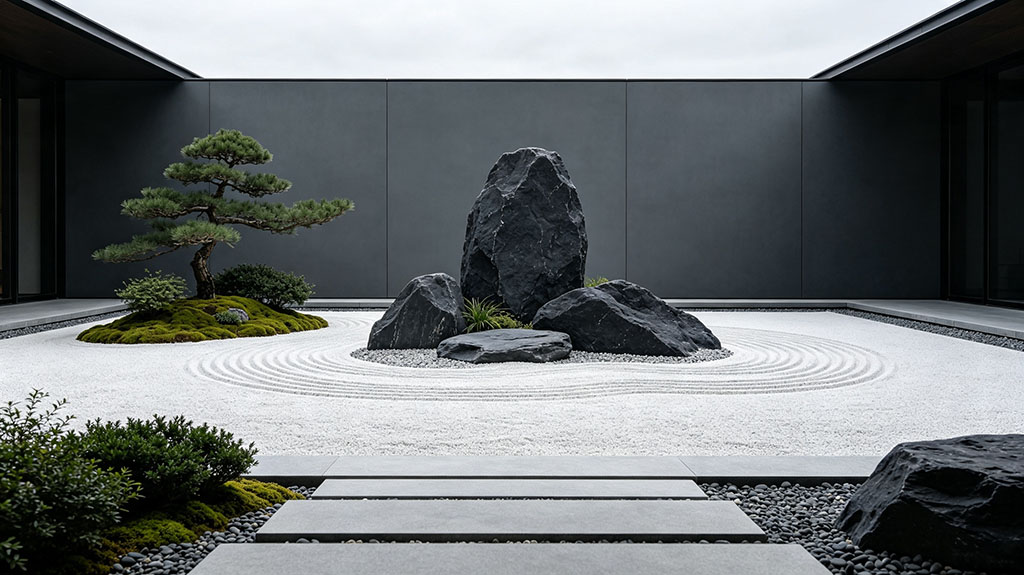
1. Core Design Concept of Dry Landscape
The essence of karesansui is not simple stone stacking, but the core logic: stones represent mountains, sand represents flowing water, and stillness represents motion.
Landscape Stones = Mountains & Islands: Natural and textured black mountain stones and wild landscape stones are adopted to simulate rolling mountain ranges.
White Sand & Gravel = Flowing Water & Ocean: Manually raked textures perfectly simulate water ripples, waves and flowing streams.
Blank Space = Artistic Conception: Adopt large-area blank sand surfaces and minimal stacking to create a quiet, healing and zen atmosphere.
Featuring minimalism, neatness, low maintenance and advanced subtle aesthetics, dry landscape is highly compatible with modern courtyards, new Chinese style and wabi-sabi style spaces.
2. Common Material Matching for Dry Landscape
A standard and mature dry landscape only requires three main materials, which is suitable for mass engineering construction:
Main Landscape Stone (Black Mountain Stone): Serves as the main mountain and island stone group. It features rough natural texture and deep dark color, forming a stable visual focus of the whole landscape.
White Washed Stone / White Sand: Paved as the base to simulate water surface, creating a clean, bright and strong color contrast effect.
Dark Gravel / Grey Crushed Stone: Used for edge trimming, space division, path paving and hierarchical transition of the landscape.
Auxiliary collocation: A small number of moss, fine bamboo, red maple and low shrubs. Keep plants to a minimum to avoid messy and complicated visual effects.
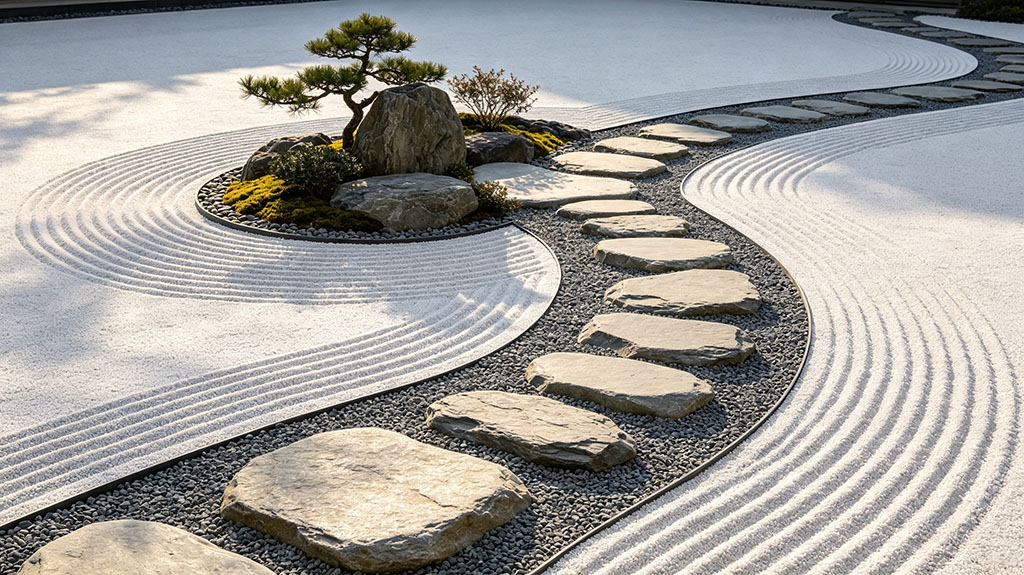
3. Three Universal Standard Layouts for Dry Landscape
3.1 One Pond and Three Mountains Layout (Classic & High-end Preference)
Derived from traditional garden etiquette, this layout presents a stable, grand and symmetrical high-end visual effect.
Layout Method: Match 1 main stone (main mountain) with 2 auxiliary stones (secondary mountains) to form a triangular composition, surrounded by white sand to simulate a fairy mountain and sea landscape.
Applicable Scenarios: Sales department main scenery, villa atriums, club entrances, tea house core landscapes.
3.2 Single-side Edge Layout (Ideal for Small & Long Courtyards)
Perfect for small-sized courtyards, long and narrow open spaces, wall corners and corridor ends.
Layout Method: Place landscape stones scattered along the wall, pave white sand in the front, and match with a small amount of edge gravel to form a layered distant mountain and near water scene.
Advantages: Space-saving, non-depressing, minimalist and durable.
3.3 Scattered Island Layout (Pure Wabi-sabi Minimalist Style)
Arrange multiple small stones in a scattered manner without rigid symmetry, simulating sporadic islands on the sea with a relaxed and tranquil atmosphere.
Applicable Scenarios: Roof gardens, balcony decoration, indoor dry landscape and homestay mini scenery.
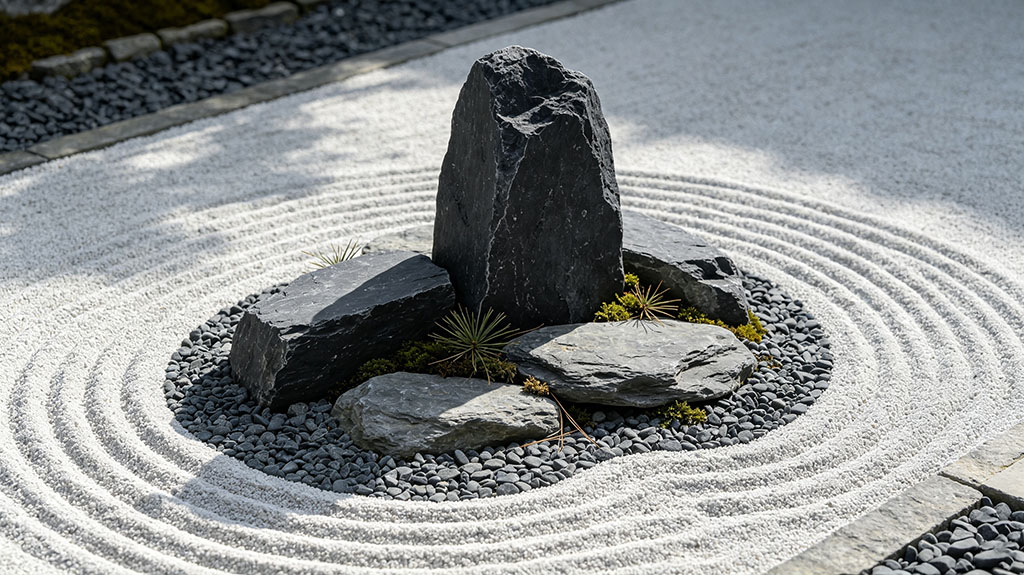
4. Golden Rules for Stone Group Placement
The placement of stone groups directly determines the advanced sense of dry landscape:
Avoid rigid symmetry and straight alignment: Do not arrange stones in a straight line or uniform size. Natural scattered collocation delivers higher aesthetics.
Clear primary and secondary sizes: Adopt the combination of one large stone, two medium stones and multiple small stones to highlight the main landscape and set off the auxiliary scenery.
Height staggered layering: Vertical stones stand as mountain peaks, flat stones lie as river banks, and height collocation simulates natural mountain layers.
Grouped placement: Avoid isolated scattered stones. Cluster stones properly to form an integrated landscape aura.
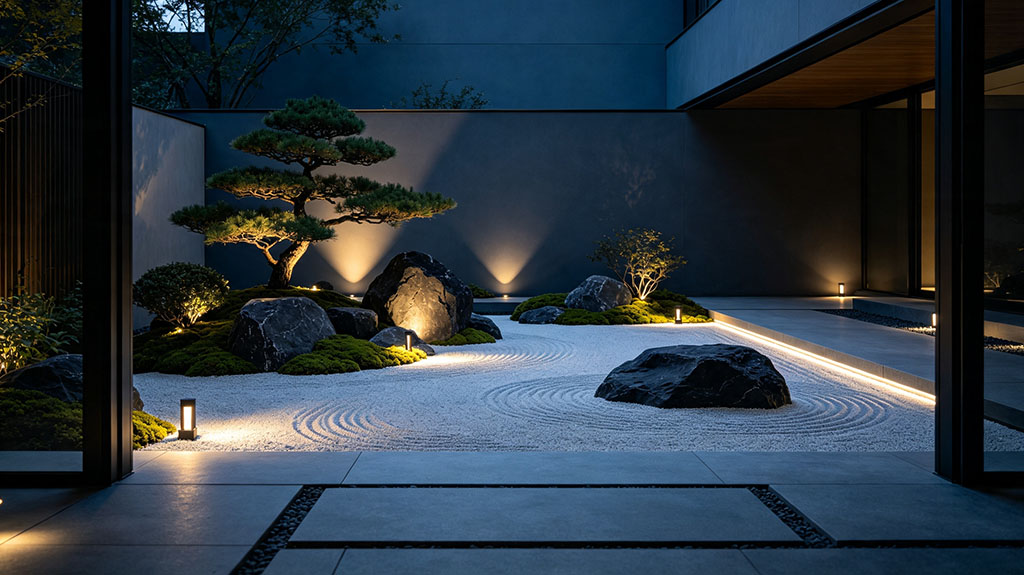
5. Sand Texture Design Techniques (Core Soul of Dry Landscape)
The overall effect of dry landscape depends half on stone grouping and half on sand texture.
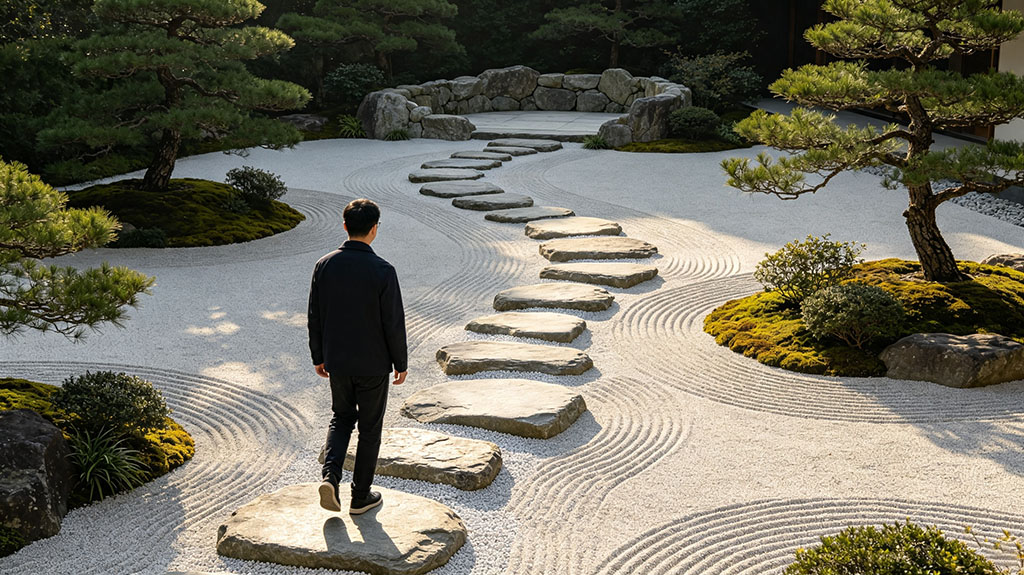
Circular Texture: Rake circular textures around stone groups to simulate surrounding mountain currents, the most classic and versatile design.
Parallel Straight Texture: Simulate calm rivers and lake surfaces with a neat and minimalist look, ideal for modern minimalist courtyards.
Wave Texture: Simulate rolling waves with flexible and natural lines, suitable for large open landscape spaces.
A high-end zen landscape requires flat sand surfaces, clear dividing lines and no sundries or weeds.
6. Size & Proportion Reference for Construction
Small Courtyard (10–30㎡): 60–80cm main stones + 30–50cm small stones, adopt simple embellishment design.
Atrium & Demonstration Zone (30–100㎡): 100–150cm main stones with multi-layer stone group collocation.
Large Square Space: Design continuous sand textures and multiple stone groups to form an integrated mountain and water landscape axis.
7. Common Dry Landscape Design Mistakes to Avoid
❌ Excessive stone stacking & crowded layout → Depressing vision and lost artistic conception
❌ Uniform stone size and neat arrangement → Rigid, dull and artificial effect
❌ Messy and excessive plants → Destroy minimalist zen atmosphere
❌ Uneven sand surface and disordered textures → Low-grade visual effect
❌ Oversized stones in narrow spaces → Unbalanced landscape proportion
8. Suitable & Unsuitable Sites for Dry Landscape
Highly Suitable Sites: Private courtyards, homestay landscapes, tea houses, sales demonstration zones, roof gardens, indoor decoration and park landscape nodes.
Unsuitable Sites: Low-lying areas with long-term water accumulation, high-frequency pedestrian areas and children’s playgrounds.
Conclusion
The advanced sense of dry landscape stems from simplicity, tranquility, blankness and naturality. Complex shapes are unnecessary. Reasonable primary and secondary stone grouping, neat sand textures and sufficient blank space can create a minimalist and soothing mountain-water artistic conception. It is currently a high-cost-performance, low-maintenance and widely adaptable high-end landscape design solution.