
How to Mix Pebbles and Washed Stones to Create a Natural-Style Garden
How to Mix Pebbles and Washed Stones to Create a Natural-Style Garden
The core of a natural-style garden is to restore the true nature and abandon deliberately carved traces. As two kinds of natural landscape stones, pebbles and washed stones—with the former being round and soft, and the latter being rough and simple—can enrich the landscape layers and highlight the natural wildness when mixed and matched. They are an excellent combination for creating a natural-style garden. The following details the specific methods from four dimensions: material selection, scene application, construction points, and matching taboos, balancing practicality and aesthetics to easily create a garden space with both ecological sense and natural charm.
I. Material Selection and Matching: Close to Nature, Balancing Adaptability and Environmental Friendliness
Material selection is the foundation for creating a natural-style garden. The core principles are "natural, unified, and complementary," while also considering environmental protection concepts to avoid damaging the natural texture and ecological balance.
1. Stone Selection: For pebbles, prioritize natural river pebbles without artificial polishing to retain their round and smooth original texture. The colors are mainly natural tones such as off-white, light gray, light brown, and blue-gray, with sizes controlled between 2-8cm to avoid excessively large or small particles. Washed stones are natural stones that have been lightly cleaned and screened, with particle sizes between 0.5-2cm. The surface retains a slight roughness and granular texture, and the color should be similar to that of pebbles. Priority is given to selecting styles with subtle differences in the same color system to form delicate layers and avoid abrupt colors.
2. Proportion Control: The matching ratio of the two stones should be reasonable to avoid messiness. It is recommended to match them in the ratio of "pebbles: washed stones = 3:2" or "2:1". For paths and leisure areas, the proportion of washed stones can be appropriately increased (to ensure flatness), and for water feature edges and flower bed borders, the proportion of pebbles can be increased (to highlight softness).
3. Environmental Protection Points: Prioritize the use of local stones to reduce energy consumption and carbon emissions during transportation; strictly prohibit the use of artificially dyed, radioactive, or harmful stones to avoid polluting the garden soil and environment; when selecting materials, prioritize recyclable stones to practice the concept of a sustainable garden.
II. Scene Application: Zoned Matching to Highlight Natural Texture and Practicality
Combine different functional areas of the garden and adopt differentiated mixed matching methods to give play to the advantages of the two stones, make the garden landscape more layered, and at the same time take into account practicality, achieving "both beauty and function".
(I) Garden Paths: Non-Slip and Durable, Highlighting Wildness
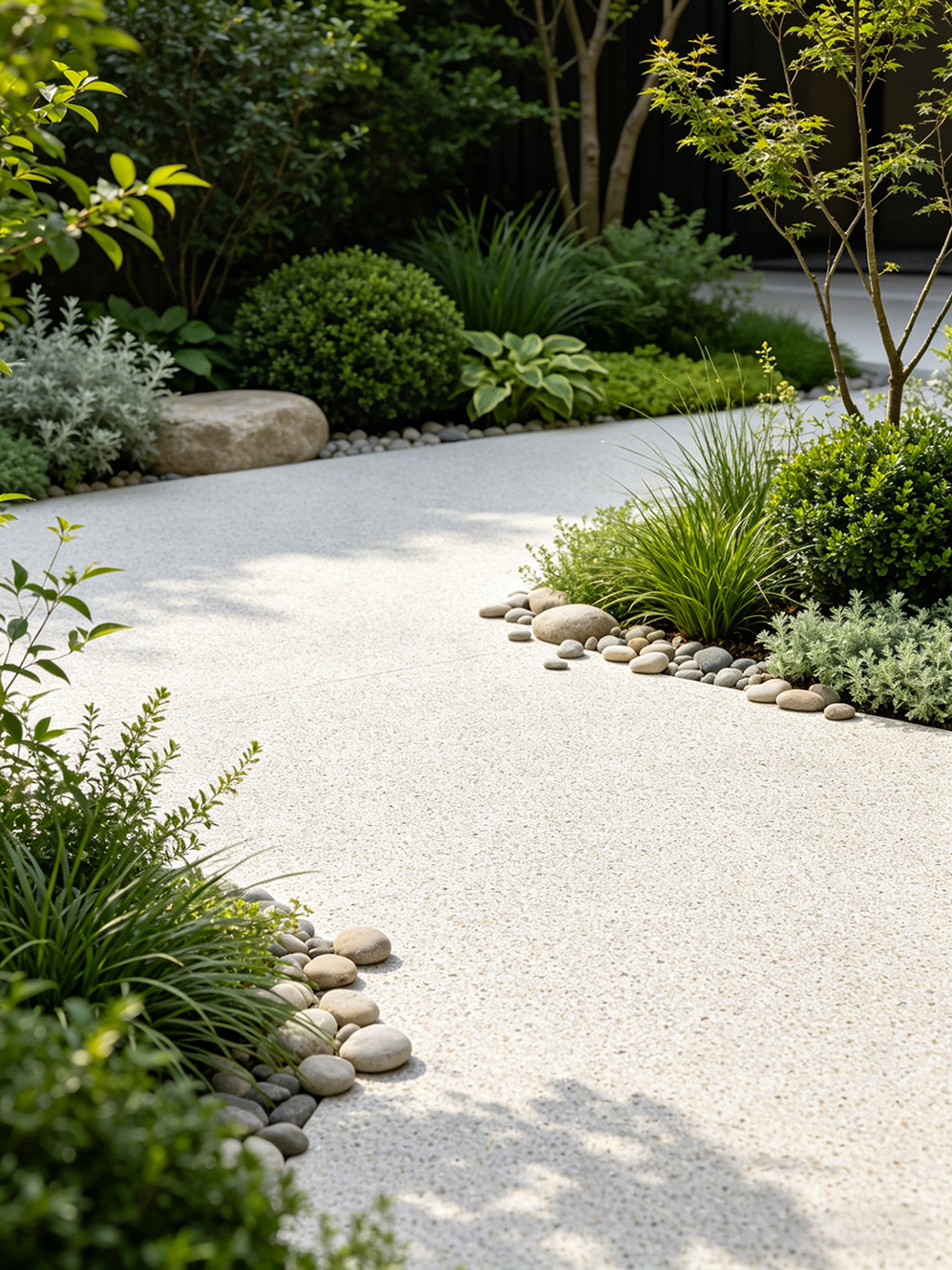
Paths are the core of the garden's traffic flow. Mixing pebbles and washed stones can not only ensure comfortable walking but also highlight the natural charm. Specific methods: first level the ground and lay a 5-8cm thick gravel base (to enhance drainage), then lay washed stones as the base with a uniform thickness of 3-5cm. A small amount of environmentally friendly formaldehyde-free adhesive can be mixed for fixation to ensure the ground is flat; then embed pebbles into the washed stones according to irregular patterns (waves, broken flowers, natural scattered shapes), with the embedding depth being 1/2-2/3 of the pebble diameter, and press gently to fix to avoid loosening; pile up irregularly sized pebbles alone on the edge of the path to form a natural boundary, forming a natural transition with the surrounding lawn and green plants to avoid abruptness.
(II) Around Water Features: Vivid and Natural, Adapting to Water Bodies
Water features are the soul of a natural-style garden. The combination of pebbles and washed stones can better highlight the vividness of the water body while taking into account water and corrosion resistance. Specific methods: use irregularly sized pebbles to pile up the water feature revetment without deliberate regularity, retaining the natural irregularity to fit the fluidity of the water body; lay a 1-2cm thick layer of fine washed stones at the bottom of the water feature, which can not only purify the water quality and absorb impurities but also set off the round luster of the pebbles. Under sunlight, the granularity of the washed stones and the warmth of the pebbles complement each other, enhancing the natural beauty of the water feature; mix and lay pebbles and washed stones around the water feature to form a natural transition, avoiding abrupt connection between the water body and the ground.
(III) Flower Beds and Green Plant Areas: Soil Protection, Weed Suppression, and Coexistence of Stones and Grass
Natural-style gardens emphasize "stones accompanying grass". The mixed matching of the two stones can take into account the functions of soil protection, weed suppression, and decoration. Specific methods: pile up pebbles into a low fence (5-10cm high) on the edge of the flower bed. The round texture can avoid scratching green plants and prevent soil erosion; mix and lay pebbles and washed stones (ratio 2:1) inside the flower bed and around the roots of green plants with a thickness of 2-3cm, which can not only suppress weed growth and reduce watering frequency but also conserve water and protect the roots of green plants. At the same time, it highlights the natural matching of green plants and stones, creating a wild atmosphere; a small amount of moss can be dotted in the gaps of the stones to further enhance the natural sense.
(IV) Leisure Areas: Comfortable and Non-Slip, Fitting the Atmosphere
The matching of leisure areas (such as around seats and terrace corners) needs to balance comfort and natural sense. Specific methods: use washed stones as the main material for the ground of the leisure platform with a thickness of 4-5cm. The rough surface is non-slip, suitable for daily activities; place 3-5 large pebbles (10-15cm in diameter) on the edge and corner of the platform, matching with shade-tolerant green plants such as moss and ferns to create a small natural micro-landscape; mix and lay pebbles and washed stones around the seats to form a natural transition, which not only avoids abrupt ground but also enhances the natural charm of the area, making the leisure time more atmospheric.
III. Construction Points: Simplify the Process, Ensure Longevity and Environmental Friendliness
The core of the construction of a natural-style garden is "simple and natural, environmentally friendly and convenient", without complex craftsmanship. The focus is on ensuring the stability and longevity of the stone matching, while reducing the impact on the environment.
1. Ground Treatment: Before construction, clean up the debris and weeds in the area, level the ground, and control the slope at 2%-3% (to facilitate drainage and avoid stone loosening due to long-term water accumulation); lay a gravel base (5-8cm thick), compact and level it to enhance drainage and ground stability. The base preferably uses waste stone particles to practice the concept of recycling.
2. Stone Paving: When laying washed stones, a small amount of environmentally friendly degradable adhesive (formaldehyde-free and odorless) can be mixed, stirred evenly and then laid to ensure the washed stones are flat and not easy to fall off; when embedding pebbles, place them according to the design pattern and press gently to fix, without excessive polishing, retaining the original texture of the stones; after paving, rinse the surface with clean water to remove floating dust, making the natural color of the stones clearer.
3. Post-Maintenance: No complex maintenance is required after construction. Only regularly clean the fallen leaves and dust on the surface of the stones to avoid scratching the stone surface with sharp objects; after the rainy season, the stones can be simply rinsed to keep their natural color; after long-term use, the stones will naturally oxidize to form a patina, becoming more warm and moist, more in line with the atmosphere of a natural-style garden, without deliberate polishing or renovation.
IV. Matching Taboos: Avoid Mistakes and Maintain Natural Tone
To create a natural-style garden, it is necessary to avoid mistakes such as over-decoration and messiness, ensuring that the matching of the two stones fits the natural tone. The specific taboos are as follows:
1. Avoid Over-Stacking: Do not stack pebbles and washed stones densely over a large area. It is necessary to reserve a certain amount of green plants, lawns, or blank space to achieve the harmonious coexistence of "stones, grass, and water", avoiding space depression and messiness, and losing the natural transparency.
2. Avoid Messy Colors: The colors of the two stones should be controlled within 2-3 natural color systems. Avoid mixing stones of multiple bright colors to avoid damaging the overall natural texture, ensuring the color is unified and soft, fitting the simplicity of the natural style.
3. Do Not Pursue Excessive Regularity: The core of the natural style is "casual and natural". During construction, there is no need to pursue absolute regularity in the placement and paving of stones. Irregular matching and scattered layout can better highlight the wildness of natural stones and avoid the abruptness of deliberate carving.
4. Avoid Material Conflict: Do not mix pebbles and washed stones with too many artificial stones (such as artificial marble, ceramic tiles), so as not to damage the natural texture. Try to maintain the unity of garden materials and highlight the core concept of "originating from nature".
V. Summary
The core of mixing pebbles and washed stones to create a natural-style garden is "respecting nature and being simple and appropriate". Through reasonable material selection, zoned matching, and standardized construction, it can not only give play to the texture advantages of the two stones but also highlight the natural wildness, while taking into account environmental protection and practicality. Without complex craftsmanship and excessive decoration, retaining the original texture of the stones, allowing the roundness of pebbles and the roughness of washed stones to complement each other, and perfectly integrating with the green plants, water bodies, and leisure facilities in the garden, you can create a natural-style garden with both natural beauty, ecological value, and comfortable experience, achieving the garden design goal of "harmonious coexistence between humans and nature".